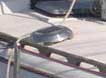
 I'm
a firm believer in boat ventilation. One of the first things I did
after buying my 28' Islander was to mount a stainless-clad Nicro solar
powered exhaust ventilator in the deck over the head. It worked like
a charm, day and night. In the day the solar cell provided enough
energy to run the fan and charge a 1.5 volt NiMH battery about the size of
a "C" cell. In the dead of winter, there isn't enough sun
here at latitude 33 to keep the fan running all night. But it
started right up the next morning. I was a happy guy and my boat
stayed dry inside. I wrote an
article about ventilation a while back and still believe nearly every
word, except the foolishness about catching the drips that come in when a
cabin-stepped mast leaks a little.
I'm
a firm believer in boat ventilation. One of the first things I did
after buying my 28' Islander was to mount a stainless-clad Nicro solar
powered exhaust ventilator in the deck over the head. It worked like
a charm, day and night. In the day the solar cell provided enough
energy to run the fan and charge a 1.5 volt NiMH battery about the size of
a "C" cell. In the dead of winter, there isn't enough sun
here at latitude 33 to keep the fan running all night. But it
started right up the next morning. I was a happy guy and my boat
stayed dry inside. I wrote an
article about ventilation a while back and still believe nearly every
word, except the foolishness about catching the drips that come in when a
cabin-stepped mast leaks a little.
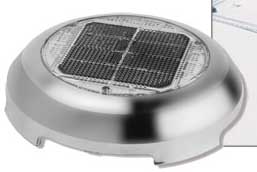 With
only 1.5 volts to work you cannot use brushless fans with electronic
inverters to generate a rotating magnetic field to spin the blades.
We're back to basic commutator-and-coils on the armature with permanent
magnets generating a field. At 1.5 volts even the brushes are
special low-resistance types. This works well, as long as it
works. Sorry the picture at left is a little lacking.
With
only 1.5 volts to work you cannot use brushless fans with electronic
inverters to generate a rotating magnetic field to spin the blades.
We're back to basic commutator-and-coils on the armature with permanent
magnets generating a field. At 1.5 volts even the brushes are
special low-resistance types. This works well, as long as it
works. Sorry the picture at left is a little lacking.
The vent fan assembly was warranted for three years. It ran well for three years. At about three years and six months, the fan died. Of course I had to take it apart to find out why. It turns out that the brushes and commutator were worn. One set of brushes was worn completely away. This may be due to the fact that I berth on the West side of LA - Long Beach harbor. Even though we are nominally upwind of the harbor, there are much cleaner, less gritty places in the world to keep a boat. At least I'd like to think so.
About three months before the boat vent fan died, my computer mother board died. This is a much more serious matter, involving hundreds of dollars and weeks of work to reconstruct the computer and get it running the way I want. This was an AMD dual-core 64 bit speedster too, one that I assembled from components. So my stock of miscellaneous nearly-obsolete computer parts was increased in the process. The processor cooling fan was particularly attractive with it's AMD hologram stuck to the center.
 After
disassembling the vent fan for post-mortem, I still had a hole in the deck
and the plastic shell of a vent fan. You can see my solution to the
problem at right. There's the AMD fan adhered to the bottom of the
Nicro battery container with a spot of some marine adhesive. I have
a good battery system on the boat, one that will power a little 12 volt
computer fan for practically ever. Nicro also makes a 12 volt
version of the vent fan without the solar cells. It is much less
expensive. I have no idea what they use for a motor. These high-tech
computer fans, however, use magnetically levitated bearings so they may
never wear out. If you look closely at the center of the spinning
fan blades, you can see the green and gold colors coming from that AMD
holographic logo.
After
disassembling the vent fan for post-mortem, I still had a hole in the deck
and the plastic shell of a vent fan. You can see my solution to the
problem at right. There's the AMD fan adhered to the bottom of the
Nicro battery container with a spot of some marine adhesive. I have
a good battery system on the boat, one that will power a little 12 volt
computer fan for practically ever. Nicro also makes a 12 volt
version of the vent fan without the solar cells. It is much less
expensive. I have no idea what they use for a motor. These high-tech
computer fans, however, use magnetically levitated bearings so they may
never wear out. If you look closely at the center of the spinning
fan blades, you can see the green and gold colors coming from that AMD
holographic logo.
I have a few suggestions if you are thinking of putting a similar Nicro fan on your boat. The stainless outer shell of the assembly was not sealed to the plastic understructure. So crevice corrosion slowly ate at the stainless from the underside, leaving rusty stains on my deck. I have an old, well-used boat and am not a particularly fastidious owner. Nevertheless, I know enough to bed everything so water cannot get between the deck and the bottom of an object and start crevice corrosion. In this case, I would have used RTV or something less viscous to seal the stainless appearance ring to the plastic guts.
[Crevice corrosion: a corrosion process that occurs in cracks or other places that are both wet and not completely open to the atmosphere. Crevice corrosion requires both water and a thin, confined space. Stainless steel, for instance, depends on contact with air to continuously form a tough chromium oxide layer on the surface of the material. Within a crevice, the water becomes oxygen depleted after the oxygen is used up making an oxide out of something, perhaps a little exposed iron on the stainless. With no oxygen in the environment, the chromium oxide layer starts disappearing, exposing more iron, which gets dissolved by the water, weeps out, is oxidized and so forth.
Aluminum is similarly protected by aluminum oxide, which cannot re-form in tight, wet places. The aluminum proceeds to dissolve. Aluminum oxide is not nearly as tough as chromium oxide, which is one reason why we build things out of stainless.]
written 7/5/09