Flushing the Holding Tank to Eliminate Sediment Accumulation.
 8 May 2009: I have installed
a "flushing" pump to inject seawater into my holding tank to get rid
of the sediment that normally accumulates. I discuss the idea in the
article below. I can report that the method works great. I
alternate pumping the tank at sea with partially refilling it with
seawater. The movement of the boat effectively sloshes the water around in
the tank, re-liquifying the sediment. After two or three flush cycles, the
tank effluent runs clear. The tank holds 28 gallons, the flushing pump
pushes about 6 gpm. I run the flush pump for a minute or two and then
empty the tank again. There is no reason this method would not work as
easily at the pumpout station, but you would have to run back and forth from the
pumpout to the flush pump controls. Two people could manage it easily.
8 May 2009: I have installed
a "flushing" pump to inject seawater into my holding tank to get rid
of the sediment that normally accumulates. I discuss the idea in the
article below. I can report that the method works great. I
alternate pumping the tank at sea with partially refilling it with
seawater. The movement of the boat effectively sloshes the water around in
the tank, re-liquifying the sediment. After two or three flush cycles, the
tank effluent runs clear. The tank holds 28 gallons, the flushing pump
pushes about 6 gpm. I run the flush pump for a minute or two and then
empty the tank again. There is no reason this method would not work as
easily at the pumpout station, but you would have to run back and forth from the
pumpout to the flush pump controls. Two people could manage it easily.
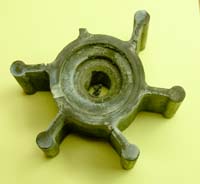
I finally replaced the impeller on the Jabsco Water Puppy. The old one was down to two working vanes and would hardly pull six inches of prime. I did a really ignorant thing when I installed the pump, which was used, of course. The impeller was missing one vane and had a definite set to the blades. I reversed the impeller so it bent the remaining blades the other way. This seemed bright until I realized that I really stressed the stiff, old blades and three cracked, one after the other, in fairly short order.
Most holding tanks get insufficient air so they become anaerobic. Anaerobic tanks are smelly. I have also installed an aquarium pump that circulates a few liters of air per minute through the tank and out the vent.
17 June 2007: Emptying a toilet bowl, you do not just pump the waste out. You flush it with some "clean" water too. Seawater in my case. Seawater has a bad reputation for causing smelly heads. The usual explanation is that the little critters in the water die in the stagnant plumbing between trips to the boat and stink up the place. I have known boats where this was a problem, it's very much a hydrogen sulfide sort of odor, but it isn't a problem on my boat. Maybe I use the boat often enough, but you would think a week or two would be lethal enough to any free-floating creature. I think the answer is more complicated, but still remains an unsolved non-problem for me.
Why not flush the holding tank too? I can tell you from experience that some holding tanks acquire a thick layer of sediment and a generous coating of noxious gray slime on the walls. This is what gums up float sensors for determining tank level. My guess is that the thick gray slime on the tank walls is an anaerobic bacterial mat that grows in the tank because the tank is never really flushed out. By pumping seawater into the holding tank at the same time it is pumped out, albeit at a lower rate, perhaps things would stay a little cleaner. I have noticed that the contents of a holding tank, while they may have been both solid and liquid to start with, rapidly become a pretty uniform brown liquid. The only solids are indigestible things like seeds and the coats of corn kernels, along with the occasional wisp of tissue fiber. Hence the "macerate" part of a macerator pump is not really necessary on a holding tank pump out.
I can tell you this because I Installed a six-inch section of 1-1/2 inch acrylic pipe in the feed line to my macerator. I have done this on several boats mostly because it makes it very easy to see when pumping hits diminishing returns. It also allows you to see what the sewage looks like. That may not appeal to you. I think it's interesting because I'm trying to figure out how to improve the general art of sanitation on a boat.
So in addition to a macerator to empty the tank, I have installed a "water puppy" to pump seawater back into the other side of the tank. Well, I intended to run water into the opposite end of the tank. But the tank fit so tightly into the available volume there is no room for a 5/8 inch hose to sneak by. Its a little early to report results as I have yet to run power to the seawater pump, but the idea is to pump out until the tank is nearly empty and then run the flush water too until the effluent clears up. Jabsco's water puppy is a flexible rubber impeller pump.
I have not been a fan of macerators. Macerators are rubber impeller pumps with 1-1/2 inch inlets with a "whirling knife" section ahead of the impeller to chop up any solids. I think diaphragm pumps are more trouble-free, either motorized or not. But a macerator is what I had and there was no room for a diaphragm pump anyway. The usual failure mode of macerators is a leak in the shaft seal dripping liquid into the motor. The solution: never mount the macerator with the motor end down. Another problem is running them dry. As long as I can see what is going into the pump, I can avoid running it dry. A final problem is not running them for a long enough time that the impeller either seizes or takes a permanent set so it will no longer pull prime. Like lots of other boat related things, the pump needs to run periodically to stay healthy. Like the raw water pump on your engine, the impeller needs to be changed out every two to 3 years. Well, maybe that's on the overly cautious side. Who enjoys maintaining their macerator? So how about whenever it starts pumping more slowly? No maintenance, works poorly, no mystery.
The impeller in any flexible rubber "vane" pump fails in several ways outlined above. The limiting life of the impeller is deterioration of the "rubber" compound. Once the material stiffens, the blades will crack or fall off and the output of the pump goes down. An impeller that is regularly used may last over five years. If it's cooling your engine, you may want to replace it every few years on general principles. Otherwise, you will notice a dramatic reduction of pumping volume with impeller failure and that's the clue.