1
December 2006: You can't get home from here.
Julie and I
set off for Avalon on Saturday. We arrived just after dark. There
wasn't much wind and we motored the last two-thirds there.
On the way to our mooring, I ran over a line in the water. It wrapped
in the
propeller and stopped us dead. OK, I've become a little
night-blind. Hired
a diver who freed us and told me I broke a blade off the propeller.
Maybe he
could get a prop by helicopter on Monday. Sounded very expensive and at
the
mercy of strangers far from home.
We spent Saturday night on the mooring. The next morning I
decided to sail
back while we still had plenty of provisions and most of our money. I
figured
that if the wind died and we got stuck between Catalina and home we
could call
for a tow. "Home" was about 23 nautical miles away. The forecast
called for 10-15 knot winds in the evening. I remembered that the
island tends
to block westerly winds and we would have a chance after we were out of
the
island's shadow.
We got a few miles out and the wind died completely. We bobbed around
until late
afternoon. With two hours of daylight remaining, the wind returned. 20
miles to
go. The wind suddenly increased to 15 knots and the boat shot along at
between 5
and 6 knots. It was a somewhat wild ride until I got the sails adjusted
for the
increased wind.
After dark the wind began to drop. 5 miles out, 5.5 knots. 4 miles out,
4.5
knots, three miles out, 3.5 knots. At this rate we would always be
nearly an
hour from home. Thankfully the wind returned just enough to keep us
moving well.
We crossed into the harbor around eight and managed to avoid the large
freighter
going out as soon as we got inside. Remember I have no engine to push
the boat,
at least not more than at a very slow speed. I tacked across the
harbor and got
to the entrance to our marina when the wind completely died. We were
able to
slowly motor into our slip on a propeller with one blade. We
stayed here and
partied instead. We plan to return to the house this afternoon
(Tuesday). Its
been fun.
You can tell how much fun it was because we have no pictures.
None.
2008
Update: Wait, the prop was ready to break.
Well, we
have two pictures taken long after
that fateful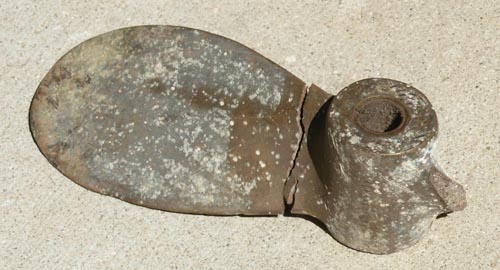 day. The one armed prop shot shows where the blade broke
off. I
examined the remaining blade closely and discovered small cracks next
to the
hub. With the hub in a vise I put a few pounds on the blade and
it broke
off, just as the other one had. Well, perhaps I put 10 pounds on
it, I
don't remember. The important thing to realize is that this prop
was
waiting to fail. It really took very little force.
day. The one armed prop shot shows where the blade broke
off. I
examined the remaining blade closely and discovered small cracks next
to the
hub. With the hub in a vise I put a few pounds on the blade and
it broke
off, just as the other one had. Well, perhaps I put 10 pounds on
it, I
don't remember. The important thing to realize is that this prop
was
waiting to fail. It really took very little force.
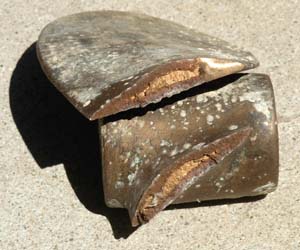
The
second photo shows what the
mating surfaces of the break looked like. The crack in the prop
had
corroded roughly a third of the way through the metal from all
sides. Only
a thin band of yellowish bronze was intact at the center of the
blade. To
make sure about the color of the material, I ground off a patch on the
blade. This shows in the second photo on the right end of the
break.
Well, un-oxidized bronze is bright golden all right.
I
put this down as a case of
stress corrosion cracking. The blades are under the highest
stress near
the hub. If there is any prop vibration, that is where the blade
bends. If this was the original prop on the boat, it went from
1976 to
2006, thirty years in salt water. The prop was "protected" from
corrosion by a zinc covered prop nut. But no electric field can
extend
into a hairline crack in the metal. Exactly what chemical
reactions occur
I leave to the metallurgists out there. You can be pretty sure
the fluid
inside the crack was oxygen depleted. What oxygen might diffuse
in would
quickly oxidize the surface of any fresh exposed metal.
This
may be a little like crevice
corrosion with stainless steel. It is the chromium oxide layer
which forms
instantly on exposed stainless that protects the iron in the
alloy. Bolt a
piece of stainless to your hull without bedding it will give you an
joint that
weeps a rusty colored stain. Bedding keeps the water out.
The
diffusion of oxygen is very slow through a crack. Therefore not
enough
chromium oxide can form. The unprotected iron reacts with the
salt water
and slowly dissolves.
At least
that's what it looks like to me.
May 1,
2009: The new propeller.

I took this
photo after polishing
the prop and propshaft when I hauled the boat out to re-paint the
bottom.
I originally polished this used propeller before I had the diver
install
it. I think keeping it clean and polished is probably more
efficient,
although that's only a guess. Polishing does make any surface
pitting or
corrosion more evident. There is also no evidence of cavitation
corrosion
which could be caused by over-speeding the prop or operating it with a
ding in
the blade.
This prop
has been well protected by the propeller shaft zincs. I install
two shaft
zinc anodes as a rule and direct the diver to replace one when they are
half
gone. From then on he waits until the remaining zinc has fallen
off (or
nearly so) and replaces it. That way I fully consume all of the
zinc
rather than replacing it when half is still
left. I polished the stainless shaft so that new zincs will be
sure to
make good electrical contact with the shaft. This is essential
for the
zinc to provide any protection to the other metal. If your zinc
is not
corroding away, it is not doing any good. Their is no downside to
having
two zincs on the shaft. It is just that most people don't do it
that
way. They waste half of the zinc as the diver generally replaces
it when
it's half-consumed to be on the cautious side.
The
strut is coated with marine
growth, but a touch of the wire brush showed that the metal was in fine
shape. To be perfectly consistent, I probably should have
polished it as
well to check for fatigue cracks. I should also have replaced all
of the
zincs, but I was very pressed for time and feel lucky I got everything
done and
the boat back in the water on schedule.
I
can tell the new propeller is a
good match to the boat and engine because the engine just reaches full
rated RPM
at wide-open throttle. No soot is evident in the exhaust.
If the
prop is undersized you will lack power and the engine will suffer from
light
loading. Diesels like to be worked, not idled. If the prop
is
oversized, the Diesel engine will not reach full RPM and will blow
black soot
out of the exhaust.
When
I first installed the
propeller it seemed like it might be pitched too high as the engine
would not
reach full RPM. That problem worked itself out after a dozen
operating
hours. I suspect the previous prop was slightly undersized and
the engine
was suffering as a result. It's a good rule to cruise at 80% of
maximum
engine RPM to prolong the life of the engine. You don't have to
be afraid
to open it up when needed, though. Under-loading the engine
causes the
cylinders to glaze up (become polished too smoothly) and the piston
rings do not
seat as well. I suspect this causes a loss of compression as well
as
insufficient lubrication of the piston rings. But I'm not a
Diesel
mechanic, so that's only a guess.
Please
remind me to let the yard paint the boat next time. Friday
afternoon to Monday morning, I've never been so exhausted in my
life. What you will do when money is tight. . .

home
|